7 main benefits of e-mail marketing

I am very interested in the benefits of Email Marketing. The more I talk about it, the more I realize that Email Marketing is considered the poor relation among the six levers of Digital Marketing.

I will detail my discussion with Laurent on the seven advantages of e-mail marketing that you should never forget.

1.A low cost with a high ROI.

E-mail marketing platforms, like Mailchimp, make it easy to design and send mailings.

With a good e-mailing tool, you don’t need to resort to expensive technical resources.

Therefore, this distribution channel has a very low cost, especially since sending e-mails is often free if you do not have thousands of subscribers.

Also, e-mail marketing tools have many advanced features.

For example, it is easy to send e-mails to your visitors based on their behavior. This practice increases engagement and, therefore, ultimately your income.

E-mail marketing especially has a higher return on investment than the other levers of online marketing.

For all these reasons, 83% of B2B Marketing managers use a newsletter in addition to their Content Marketing

2. Second advantage of e-mail marketing: simplicity and ease

By investing in Mailchimp or another tool, you design e-mail marketing campaigns with just a few clicks.

This is done in 3 steps:

  • Design the template of your e-mail directly in the e-mail editor integrated into your platform. Also no need for knowledge of HTML; a good editor has a tool for previewing your e-mail in real-time,
  • Choose the contact group to send your message to,
  • Press “send”.

The segmentation of your subscribers’ e-mail addresses and the personalization of the content of your e-mails are also very easy to set up.

In this way, you, therefore, target specific customers with a personalized and more impactful message.

3. “Surgical” targeting

Want to offer a 25% discount on pizza orders to men aged 18-35 in the Grenoble area?

Easy with MailChimp!

It is necessary beforehand to collect the necessary data to realize the segment of your customers.

Other great ideas:

  • Relaunch your subscribers who have not opened your first e-mail 48 hours after sending. One-click and let’s go!
  • Contact your customers who have abandoned products in their cart on your e-commerce site to encourage them to finish the sale.

Does that sound magical to you?

Not really: just a good tool and a little practice.

Also, this type of follow-up e-mail is very easy to automate!

Then, to properly “educate” your prospects, design a series of e-mails giving them the right information at the right time.

If they find your e-mails relevant, these prospects will end up contacting you one way or another.

4. Send personalized messages

E-mail marketing is an effective way to add your flair to your marketing. With Mailchimp, you personalize your e-mail campaigns in several ways, and of course, at no additional cost.

In one click, you add in your e-mail:

  • The name of the client,
  • His city,
  • The history of its orders …

With this kind of personalization, your customers feel valued, even if, in reality, everyone on your e-mail list receives a little different message.

5. Immediate delivery

If you want to reach within the next five whole minutes or a segment of your customer base with a personalized message, e-mail marketing is the most reliable way to do it.

Also, unlike publications on social networks, you have complete control over the distribution of your message.

Text messaging campaigns are also a fast way to send a message, but sending text messages can get costly. Immediacy is, without context, one of the advantages of e-mail marketing.

6. A fast response rate

A lot of businesses submit their e-mail marketing program (“Nag” campaigns) from a “unanswered@your-site.com” address.

Bad idea: you don’t encourage your customers to contact you.

It is a solution if you have millions of subscribers.

On the other hand, for a base with few subscribers, e-mail marketing is also a way to encourage your customers to get in touch with you.

So take the time, get to know your customers, respond to them promptly, and ask for their opinion. This will set the stage for a sale.

A little tip: by putting your name next to the sending e-mail address, your e-mail is immediately more “human,” and therefore, you will see an increase in the return rate from your readers.

By leaving the door open for dialogue, e-mail marketing is also a way to communicate quickly and effectively with your subscribers.

7. Measurable monitoring

As a result of the Internet Marketing return on investment proving difficult to create, it’s generally difficult to figure.

You need to know how your clients get from their current website to your services. Of course, there are mechanisms in place to monitor the guests.

But e-mail marketing is the only two-way way to capture your subscribers’ interests and easily calculate the ROI of a campaign.

To evaluate the output of your e-mail marketing campaigns, you have access to the following keywords, which include: In Enquiry, Out: Answer.

  • The cumulative number of e-mail messages (msgs.) inside the mailbox.
  • How many people clicked to open it,
  • A consumer clicks on a page about air pollution.
  • Even the income produced by this would become even greater.

You can also view reports with details such as the e-mail client being used and your customers’ profiles.

With all the signs suggesting positive buy-in and progress, you evaluate, test, and refine your next e-mail marketing strategies to increase your buyer engagement and pique their interest.

To conclude on the advantages of e-mail marketing

Choose your sending tool and get started. Your efforts are rewarded thanks to the seven main advantages of e-mail marketing very quickly:

Last point: all you have to do is learn how to collect your visitors’ e-mail addresses on your business website.

Are you looking for an expert for digital marketing of your business? We offer Social Media Marketing in Pakistan at an economical price. Our social media experts certainly put their heads together on this. We make sure that we remain one step ahead of the industry through our excellent services to provide you with the best services.
The advantages and disadvantages of natural referencing

The advantages and disadvantages of natural referencing

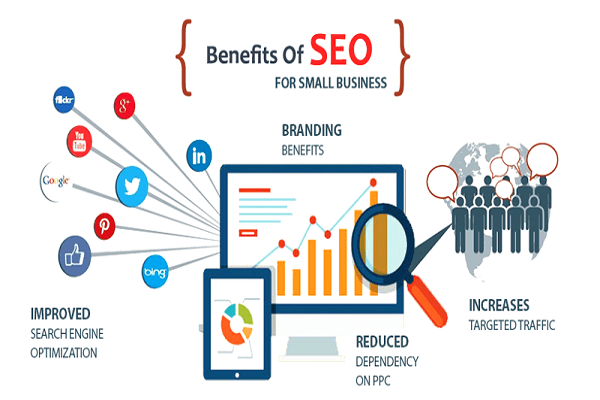
As a web marketing specialist, I often have to answer these two questions: how to increase my website traffic and what is the best strategy between natural referencing and paid referencing? I therefore take the opportunity given to me by Thibault to present to you the advantages and disadvantages of natural referencing (SEO) compared to paid referencing (like Google AdWords).

The advantages of natural referencing

1 / Take more space in the results

I will say the main advantage of SEO is the fact that we can occupy multiple positions in the search results, unlike paid SEO which only allows one position per advertiser:

By occupying several places in the natural results of Google, you considerably increase your chances of obtaining a good click-through rate and therefore of traffic to your site. Consider all the same to optimize your content to obtain optimal results.

2 / Get more qualified traffic

The second big advantage of SEO is the fact that it records better conversion rates compared to paid SEO (which, in a sense, makes perfect sense). In fact, being that “you only have to pay” to appear at the top of Google AdWords search results, anyone can position themselves for just about any query, without the content being. super relevant. There are some rules to follow, but as long as you get GG fat it will be quite tolerant .

The natural referencing following a more strict logic, the traffic that you will receive thanks to your positioning will be much more qualified (approximately 40%).

3 / It’s free!

Logical but still worth mentioning: unlike paid SEO where you pay every time someone clicks on your ad, SEO is 100% free. It may seem trivial, but when you hit cost per click of $ 7 or $ 8 in certain industries (such as Finance or Law), the portfolio can quickly steal.

The disadvantages of natural referencing

1 / It’s long

eztrgThe main drawback that I have to explain to my clients who hesitate between SEO and paid SEO is the fact that SEO takes a lot longer in terms of results. Indeed, while it only takes a few hours (when done correctly) to build your Google AdWords campaigns and see yourself at the top of search results, it usually takes several months to see yourself appear on the first page on words. keys you are targeting. It is therefore necessary to be patient and not immediately depend on the traffic of your website to keep your business alive because the wait can be scary. Natural referencing is a long-term strategy that requires rigor and regular monitoring of results to avoid wasting time on too competitive requests or which generate too little qualified traffic. The first step is therefore to carry out akeyword research and then put in place a suitable content strategy.

2 / it takes time

Another point that I often have to explain: natural referencing requires a lot of time and energy if you want to keep your positions in a sustainable way. Indeed, SEO is mainly based on content and its optimization. In order for Google to take your site (or page) seriously, you need to feed it with content and organize it so that bots understand what the topic of the page is about and what word to position it on. I recommend writing texts of 500 words or more to have a chance to correctly reference yourself.

When you start your SEO strategy, you are often super motivated and you have lots of articles in your head. We tell ourselves that it will be easy to beat your competitors once the content is written. The problem is, writing content is long and tiring. When you have written 5 or 6 articles of 800 or 1000 words, you will realize why I say that SEO takes time and energy …

3 / Fight to keep your places!

Last good news: you have to maintain your natural referencing constantly! Did you manage to position yourself on the terms you wanted and life is good? Yes, but don’t think that those you have dethroned are going to sit idly by and watch you take their places. They will necessarily react to recover their positioning and you will start your competition to keep your places. So you need to put in place a good copywriting and optimization strategy so that your efforts don’t evaporate too quickly.

Hope you enjoyed this article. If you want get strategy of seo services in Pakistan than take this opportunity today.

SEO optimization - over ten concrete tips that no one gives you

SEO optimization – over ten concrete tips that no one gives you

SEO optimization is a challenging field. In the real world, it means optimizing your site for search engines. Whether we like it or not, we refer especially to Google, at least in the world when we talk about search engines. You can find a list of the key items you should do to optimize the site in this post. The abbreviation SEO comes from English: Optimization of search engines.

After SEO optimization or web optimization, you can find several businesses that will sell you SEO services if you do a Google search. I did not write this article to provide you with SEO services in Pakistan. I wrote this article so that anyone who searches on google: SEO optimization to understand in a language as accessible as possible what this SEO optimization means more concretely.

Whether you want to do SEO yourself or outsource all or part of this activity, it is good to know what this SEO activity entails. I took care of the training URL.ro site, which occupies one of the first three positions in google for what we are interested in, such as human resources manager course, trainer course, public procurement course, sales training, etc.)

So what would you do to maximize SEO?

1. Use the keyword planner

Here is the minus, from my point of view, steps you have to take. The explanation is simple: you need to know exactly what you want to know from the start. Achieve what expressions you want to rank well in the google ranking. In vain, do you For SEO, index and refine what individuals are not searching for. Act clever from the beginning and optimize with what attracts you. In detail, I present how to do this in marketing academy, module 7. However, the basic idea is simple: determine which expressions you want to do SEO and check in the keyword planner what volume of queries you have on the respective expressions/expressions.

2. Install a tool to help you in SEO optimization

Depending on what platform you have the website on, I prefer WordPress. For WordPress, you install the Yoast plugin, which is free, and it tells you exactly what you are doing well and what you are not doing well. It is easy to use.

3. Optimize your article titles

Once you have decided to target a keyword or phrase, it should appear in your article’s title. It is important to be relevant and clear.

4. Link optimization

I prefer that once I have targeted a keyword, the link must be exactly the keyword beyond the name of the website. It is friendly for both Google and users.

5. Optimization of meta descriptions

When you publish an article, you have to add a meta description. This is a kind of Google-read description. Basically, from the title, link, and meta description, google understands what it is about.

Usually, but not always, this meta description appears on google. And this meta description must contain the key phrase, be relevant to the phrase you are targeting, and at the same time attractive and relevant to the user who sees it on google. For this meta description, you have a rubric in Yoast.

6. Optimization of introduction and content

There are many theories about how often the keyword should appear in the article. I don’t think there is a 100% true answer. It should appear a few times, at least 3-5 times, however how much you stretch with the insertion of the key phrase in the article, is more a matter of common sense.

When you feel that you are exaggerating, it would be good to stop because google will conclude. So, in the first line, then in the email, type your keyword. The point is, the frequency of your keyword should be natural once you write about it.

7. Headings and subtitles optimization

It would be best to choose whether you write an article, what the title is and what the subtitle is. Think of these titles and subtitles as a kind of book content. These headlines help google to understand the structure of your article. This organization of content will also help the user.

Basically, in the titles and subtitles in the article, instead of visually identifying the titles by putting a larger or smaller font size, you use heading options 1, 2, 3, or 4. If you install WordPress in Romanian, you will see exactly as in the image below (subtitle 1, subtitle 2, etc.). I usually think about this structure before writing the article, but you can do it after.

8. Optimize content images

When it comes to images, three things are important:

image optimization and other text

the relevance of the picture to the key phrase

optimize it in terms of size (not too big, i.e., somewhere at a maximum of 100 KB)

add another text  ( alternate text) that contains at least one of the keywords (if you have more)

9. Insertion of external and internal links

It is recommended that you insert at least two links to other content on your site (inbound link) and one to an external site. It is preferable that the links are relevant and helpful to the user not to be placed artificially just because they need to be placed.

10. Add tags and categories

At the end of the articles, you have to add tags (labels). Here you enter relevant expressions from which to briefly understand what topics your article touches on. You can also enter expressions from the word family of the targeted expression, provided you have talked about that in the article. If you didn’t talk, you would risk a Google penalty.

Ten tips to improve the SEO of a WordPress site

 Ten principles to follow to promote the SEO of a site powered by WordPress.

1. Regularly crawl your site

First tip: regularly analyze your site like Google would using crawl tools like OnCrawl or Screaming Frog. These reports are very instructive and allow you to know your site. Thanks to regular crawls, you identify the optimizations to be made and the errors to be corrected by placing yourself from an “external” point of view, which mimics the functioning of the Googlebot.

2. Hunt unnecessary content

During crawls, we often discover many unsuspected pages, the interest of which must be questioned. Hunting for unnecessary content saves crawl budget and thus refocuses popularity, and therefore the attention of the Google bot on the content interests you. If the visualizations offered by the crawl tools are not enough for you, you can test Gephy to visualize these orphan pages in the structure of your site. You can also use Google Analytics to identify pages that do not or little Traffic and study the interest of action on these pages: should they be updated, should they be deleted …

3. Design rich content

A web page must meet a need expressed by the user. Quality in the sense of the user and the engine’s sense are two different notions, but you should succeed in positioning your pages if they correspond to the users’ expectations. Enriching pages with visual elements can be very effective: Daniel Roch takes the example of the test pages of the LesNumeriques site, which are often very high placed when you are looking for information on a product. They contain complete and technical descriptions, photos, opinions, videos, comments… These pages attract natural links. To know what it would be good to offer, it is advisable to make your target query on Google and look at the content of pages that are well referenced:

4. Write real content

Many accessible techniques allow you to grab content from one location, transform it and publish it on your site automatically. These spinning methods are often effective in the short term, which can attract web professionals. On the other hand, this content has less potential in the longer term, and the user interest is very often close to nothing. Instead, focus on the design of real content to attract and convince Internet users.

5. Know your products

On many requests, we come across well-referenced articles written by SEOs. It’s hardly more interesting than the spinning content. The themes are very varied, and very often, affiliate links make it possible to monetize the efforts made to access these highly sought-after positions. The interest is often limited for the user because the contents were written by people who do not know the topic – they use very effective tools to find the expressions to please Google. The engine still overvalues ​​that content a lot – but if you can easily spot content written by an SEO, that means quality raters can see it too.

These sites can be penalized manually or undergo updates to more general algorithms, making it possible to tend towards a more qualitative web. For your site, use the expertise that surrounds you, do not entrust the writing to an SEO (the SEO advises, the writer writes based on his expertise), and get to know your products well: this is the best option for a long term strategy.

6. Optimize performance

Google highly encourages websites to be fast, and everybody gains when a site gets faster. A client who is satisfied with the outcome of his/her experience; the website, which gets higher conversions; and Google, which would use fewer resources to crawl websites. Concretely, Be like Usain Bolt in the sport of running, whose website takes more than 10 seconds to load … There is enough time to complete the 100-meter sprint.

On WordPress, to improve your performance, it is advisable to set up a cache system (with WP Rocket, for example), compress the images (many plugins also exist), never use an extension like Divi or Elementor to build its website (it’s simpler, but it generates lines of code or even completely useless pages that can degrade the performance of your site) and to optimize the PHP code of its website and remove any superfluous element.

7. Improve accessibility

Improving the accessibility of your site makes it possible to meet the needs of people with visual, hearing, motor, and cognitive disabilities. In doing so, you will also meet the needs of Google, which is blind, deaf, which has no hand (it does not manually click on links, it follows links as they appear in the DOM), and who cognitively speaking does not understand much of what you are writing. Actions in favor of accessibility always have a positive SEO impact.

Think about alternative texts, description of videos, navigation paths, explain as much as possible, check how your site works without JavaScript, take a good look at your Hn markup, remove unnecessary links, simplify your design as much as possible, and offer a site too accessible on mobile than on PC. These elements should be understood by developers and writers who write articles on your site (especially for alt texts and descriptions of videos).

8. Guarantee security

Securing your site is important: this allows you to protect yourself, as best as possible, against pirates who could replace your content or add links to unsavory sites … Some do not hide and are easily spotted; others do cloaking to hide the malicious links they inject into hacked sites.

When we talk about securing our site, it is not simply using the HTTPS protocol. It is above all: to carry out regular backups (to recover its contents easily in the event of an attack); properly configure your access and wp-config.php file; control its accommodation; keep your CMS up to date; use security extensions (like SecuPress or Wordfence, Daniel Roch preferring the first to the second); and carefully manage the rights granted to users.

9. Obey the law

This is just evident and not true as many places do not follow the rules. What is shown should be dealt with carefully. We cannot stress enough that under French law, sponsored content must be identified as such. Otherwise, you risk prosecution; that Google asks to put the links inserted in these articles in rel = sponsored; That allows people to buy links, which violates Google policy, you risk being penalized… purchase links from the website. GDPR has implemented a variety of restrictions on entities that are manipulating EU citizens’ data.

Depending on your market, your sector, the products you sell, the content you offer, check the legal principles to be respected. And never forget that just because it can be done doesn’t mean it’s legal. Two legal decisions related to SEO deserve to be known: Saveur Bière (unfair competition) and Rue du commerce (trademark infringement).

10. Get links

The links made between web pages constitute a fundamental element of SEO. These web links help Google crawl pages, understand their relationships, and assess pages’ popularity. Link Farms are commonly used to improve the domain visibility of Websites.

In the long run, manually placed links won’t allow your site to outperform the competition. These natural connections are acquired with third parties because they believe in doing so. You can contact sites that cite you without a backlink to get a link that seems relevant, but you should especially focus on your content. Creating good content, original, relevant, appreciated, which resonates with a community or the media, will always be the best way to get perfectly natural links from many authoritative sites. This advice applies to all sites, regardless of their technology.

Want to improve the SEO of a WordPress site? Our SEO services in Pakistan help you to improve your ranking and enhance your Traffic. We use cutting edge tools, techniques, strategies, and trends to help you move up in search engines. Our SEO campaigns include competitor research, keyword research, and content implementation.